Here’s another first for me: I just received the text which will go on the back cover. So, people sit in a room and talk about good ways to describe my book? Um… rad.
It’s 1984. Fairies have broken into the human world. And they’ve discovered computers.
Punk hacker Robin Levesque’s job is to protect humans in the Annwn Simulation from goblins, piskies, and other fey beasties. Nothing she can’t handle with a Commodore 64 and a few lines of code.
When her brother is kidnapped by a headbanger who trades in blackmarket boons, Robin descends into a world more dangerous than any she’s ever known. The police are no help, and her bosses at the Eldritch Equipment Corporation refuse even to investigate. Then Robin herself is accused of magical crimes…
“We need to make blank scary again”, where blank is a classic horror villain.
We hear this all the time from those who grind their teeth over slapstick zombies and dreamy-eyed werewolves. Lovecraft is due for this treatment; a quick etsy search is all it takes to see that the Elder Gods have gone kawaii. The H.P. Hipsters are soon to follow. “The Cats of Ulthar? You’ve prolly never heard of it.”
But what was it that made Lovecraft so very scary in the first place? And does the mythos have anything to say to contemporary readers anymore? Enter The Litany of Earth, a novella by Ruthanna Emrys currently up on tor.com.
The state took Aphra away from Innsmouth. They took her history, her home, her family, her god. They tried to take the sea. Now, years later, when she is just beginning to rebuild a life, an agent of that government intrudes on her life again, with an offer she wishes she could refuse.
Firstly, this is a story which stands on its own. You don’t need to know the lore to enjoy it, though if you do, you’ll appreciate how skillfully the details of the world are worked into the narrative.
We are presented immediately with one variation from Lovecraft’s world (at least in my reading of his work). It is not tentacled aliens which make us build internment camps. No voice from the depths caused the atrocities of World War II. The author takes us out of the expected universe of musty tomes and eerie languages and brings us into a much more applicable world: one in which we are the monsters.
But those kooky old gods are still around; don’t worry. And Emrys handles them just as well.
Why were those adorable elders so terrifying to Lovecraft’s readers? I wrote a post on this a while ago, and it seems to me that the concepts in his work — that great and powerful forces exist which are either indifferent towards us or actively want us dead, that there is no benevolent God to protect us — must have been pretty creeptastic to certain readers back in the day. But why are they scary now?
Here the author presents to us a post-Innsmouth worldview, in the form of semi-religious magic and ritual. This world will die. You will die. Maybe some stories of humanity will live on. None of it means anything. And that’s OK.
The protagonist describes this as “cosmic humility”, a phrase which I will be citing as often as I can.
This ain’t no fan-fic. This story is a re-evaluation of HPL’s canon from a contemporary viewpoint, deftly handled by the author. So go read it!
My last post was about the new cyberpunk, defined by mobility, omni-connectivity, and slick black-and-white style. So I did what I always do: started a tumblr about it.
I wrote a story, too. It’s going through the submission gauntlet right now, so here’s hoping.
I came to cyberpunk late, really. I read Snow Crash in ’98. The Matrix came shortly after, prompting some very obsessive behavior on my part. (I suppose I did watch Max Headroom back in the day, but the previous two mentions were the biggies for me). Etc. Etc.
Traditional cyberpunk, with all its pantone trappings, started a strong tech archetype: going in. The Metaverse is separate from the real world, and as blurred as the lines may get, they’re still lines. It’s a personality in the cable network, a terrorist in a shared dream. You jack in, log on, get inside.
The new cyberpunk doesn’t work this way, nor should it. The Verge posted a great article recently on “Tumblr’s cyberpunk renaissance”, in which the author cleverly points out that
Our Matrix is so much more diffuse, and our enemies so omnipresent — it’s the NSA tapping the iPhone in your pocket, the webcam in your shiny new MacBook Air. There really is no pulling out the jack.
Gone is the mighty edifice and the slick decker slicing his way in. It’s damn everywhere. Take out the main data warehouse? Please. It’s all redundant systems now, chirping to each other like a flock of birds. Kill one bird, the flock still lives.
And if that weren’t enough, we’re willing participants. We live online, knowing full well data on everything we do, everywhere we go, everyone we speak to is up for grabs.
So, what does this mean for cyberpunk now?
From a stylistic standpoint, the Verge article is the place to go. “…a hyper-refined and expensive sense of taste, favoring clean lines, baller outfits, powerful matte-black weapons, and the kind of opulence telegraphed by machines without visible seams.” Cyberpunk is as much about style as it is about tech, and the new stuff will follow suit. Check the Verge article for visual reference.
I’ve come across a two touchpoint characters and works which resonate with where the genre is headed.
Ken Liu’s The Perfect Match gives us Centillion, or ‘Tilly’, the omnipresent Google-like voice which serves as a personal assistant, recommendation engine, and Jiminy Cricket to everyone. This is our world now. It’s not some evil government — it’s a convenient service we all sign up for.
The story even gives us one of these new cyberpunks in Jenny, who wears “a thick winter coat, ski goggles, and a long, dark scarf that covered her hair and the rest of her face” in order to muddle the perpetual identity detection. Forget black jackets and mirrored glasses; it’s all ugly T-shirts and facial asymmetry.
After that, it’s Ubisoft’s upcoming Watch Dogs. Sitting at a screen is so 2000’s, as is hacking some static mainframe. Let’s talk about controlling traffic lights and city electric grids from your phone. Today’s tech rogues are on the move, and they can see everything about you in a little box floating over your head.
This is how the new cyberpunk works. The distinction between on the grid and off the grid is gone. There is no “going in”. And, perhaps more importantly, there is no getting out.
I have spent a notable amount of my life in virtual worlds. One of my games, and my upcoming novel, are set in one, in fact. The big ones:
I dallied a year in World of Warcraft, which was essentially running around in a fantasy world and wondering when my friends were jumping on. Meh.
I spent many moons in Second Life, which allowed me to actually make stuff. I built a few airships, and a little brass orb that followed me around and talked to people. This was fun.
Fun, but limited. At a certain point in WoW, I had done everything that didn’t require a three-hour minimum play time. I didn’t want to start paying for space in Second Life, and most of places I went were pretty barren.
This is what I want — to jump in as I see fit, be able to get together with friends, and see a ton of content, preferably user-made.
I recently read this article on MicroMUSE, a 1990-era text-based MUD which allowed users to build their own environment. Come on, now. Green-on-black text and freedom to create? This sounds perfect.
Having never played on a MUD (“played a MUD”? “been in a MUD”?), I figured it was time. I found a list and got to it.
I set up a character and played about fifteen minutes on a Tolkien MUD, right up until the NPC Numenorean who was showing me around ordered a beer and it came in a bottle. Napes.
Then I came across a cyberpunk-themed thing. Oh, why not.
So, this MUD, which I choose not to name, starts you off on a street filled with strip clubs, prostitution, and sex acts right out in the open. Fine. Sure. Dark streets, seedy underbellies, glowing neon. Straight pantone. But, the very first area you enter is the sex industry neighborhood?
Before long, an admin pulled me out of the game and put me in some sort of holding center until I wrote a history for my character. I did. Ah, but it was not good enough.
So I fleshed it out. And then received revision notes. This process took two days.
Finally, having passed this enforced-character-background barrier, I got back to it. Where “it” was wandering around from street to street watching kidnappings and harassment I could do nothing to stop. Just background text, apparently; the same way you might see “there is a tapestry on the wall”.
And here’s the kicker — the in-character chat was lame at best. Discussion of how fat a character is. Claims of sexual prowess. When I asked in the out-of -character help chat where I could buy a sword (this is cyberpunk, after all), I was told to look in stores. Oh, and anything can be a weapon in this game. And that’s an in-character question and should be asked somewhere else and here’s a link to the rules.
This is my problem with virtual worlds. The internet is other people, just like Hell.
I hear good things about Minecraft, but I don’t particularly want to play shared Legos. Something text-based seems perfect, or even something with basic graphics. Something we can jump in on from a handheld or phone. Where I don’t have to interface with anyone I don’t want to, but can easily join groups etc. Second Life without the graphics engine.
80’s hackers, punk mages, &fey magic. Coder/wizard fights to get her bro back, finds dangerous secret. #PitMad
In September, I posted this tweet without much expectation that anyone would take interest. But I had been diligently knocking my head against the querying process for six months by this point, and the Pitch Madness twitter event seemed like it would be worth a shot.
I received a manuscript request from, of all places, Harlequin. Turned out they had just started up a new digital program. and were in the market for some sci-fi and fantasy. And not just SFF romance, either. Regular old SFF.
Huh.
Five months later I received a call from the editor. She dug it. She wanted to send me a contract.
Huh!
And thus began the process. We’re through the first round of edits now, and there are a few items I want to remember, which I shall now list:
Working in a professional capacity with someone who both a) believes in the concept and b) has solid ideas on how to make this baby purr is magnificent.
I remembered maybe one in five words from that initial phone call.
All that cool stuff you came up with as you were writing the thing? Make sure it’s all in the first part of the book.
I really can’t believe I sent out a manuscript with that many “said”s in it.
Saw a cool book cover on a website. Filed it away in the mind palace.
Some months later, saw the author’s quote on the cover of a book I liked.
Decided to buy the first book of the series. Bought it on Kindle. I mean, it’s cheaper and I could start it right away and I have this Kindle and everything.
Read it. Decided to buy the second book of the series. Decided to go with paper this time, since the codex format really is the best way to read book.
Went to my local indie bookstore like dutiful book guy. They didn’t have it.
The Moby Dick game is brilliant. It is beautifully done, for starters, with a depth of artistic detail which makes the game a must-own for anyone who decorates their home with old papers, faded prints, scraps torn from books. You know who you are. Every single one of the cards is worthy of matting, framing, and displaying in a prominent locations around your home, library, book-store, boathouse, or secret society lair, as is the box itself.
Gorgeous, right?
All that aside, though, it’s the deft creation of a particular feeling which makes the game notable in this case. This is not a game about beating the odds, forming a briliiant strategy, or fooling your opponents, though these skills certainly come in to play. In this game, you combat the constant feelings of dread as you lower down to hunt a whale, and shore up your defenses as best you can against the inevitable face-off with the great beast himself. In the rounds I’ve played, the term “bleak” has come up several times. You’re a whaler — you’re as likely to die as not from thousand varieties of bad luck. And the captain is driving you towards a near-certain doom.
At what low value was held the whaler’s life. The player feels a detachment from the lives of the crew. They’ll all end up dead anyway, often even before facing Moby Dick himself; best not to grow too fond. And what an unusually various crew it is. Men from all over, regardless of race or creed, hauling alongside each other where on land they would not be allowed to eat at the same table.
It’s about risk and reward and risk and risk. And these elements translate very well into a space-faring adventure.
Black Flag
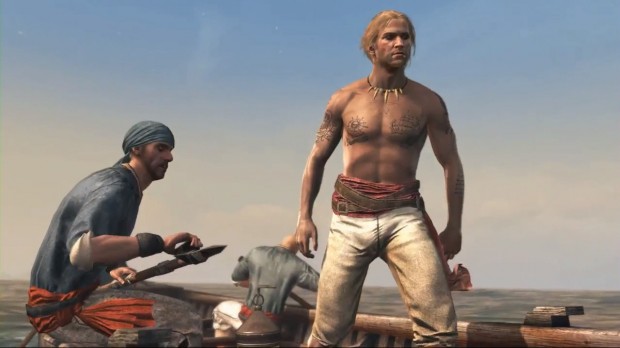
Where the card game is about staving off despair in a merciless world, whaling in Black Flag is about high adventure and bare-chested virility.
I mean, come on.
Here, the feeling is excitement. You won’t die if the whale attacks you. A snapped line doesn’t whip anyone’s arm off. You want to land that harpoon throw and reap the rewards, Caribbean sun beating down on your back. It’s… a lot of fun.
Side note: I felt substantially more guilty for killing a whale than for plundering dozens of ships. Odd.
Again, even as you glory in the thrill of the hunt, you feel as if whale oil must had value far beyond gold or jewels to be worth its pursuit. And again, why would this not translate to the emptiness and danger of space?
Artemis
Tell me you’ve played this. A fantastic, home-grown spaceship simulation game which hooks everyone who touches it. My first experience with it was at a gaming convention, where the developer helped players through the basics and let us cruise around. And that’s when I first came across the rare space whale.
To the larboard!
A fun addition to the game, almost an easter egg. You don’t get anything for finding them, or indeed for shooting them down. They’re just there, making their way through the emptiness.
And they’re beautiful.
From the Void
With all of this percolating in my headspace, it was only natural my protagonist would find himself on the hunt, facing one of the great dangers of the nullity for a chance at a share of the valuable nano-oil which can only be found in the skull of the voidwhale.
Check it out if you want, and I’d love to hear what you think. You can subscribe here, too.
Is the long, empty trader’s route between Calpimede and Freischutz fraught with piracy? A hidden star-station which flies no flag?
Why did the Navy set up a base in the asteroid belt of Igerna, at the bottleneck between Huma and the twin planets of Jachin and Boaz?
Who gets assigned to the distant scout station above Fontarabia?
Oh, space adventure. I love you so.
World-building should serve the narrative… or does a well-built world prompt new stories? Much of the history and technology of the world in my podcast has been developed over the various stories I have set therein, but whenever my characters set out for somewhere new, I stall a little. What’s it like over there? Why?
Enter Traveller. I grew up in the height of the “D&D causes suicide/satanism” witch hunt — and in New England, no less — so, my exposure to classic tabletop RPG’s is limited (I’m doing my best to catch up, I promise). Lev Grossman‘s The Magician King makes a reference to an old sci-fi game in a way no self-respecting geek with internet access could resist. And, wouldn’t you know it, the 1983 starter box is available for free right now (and, to all appearances, legally).
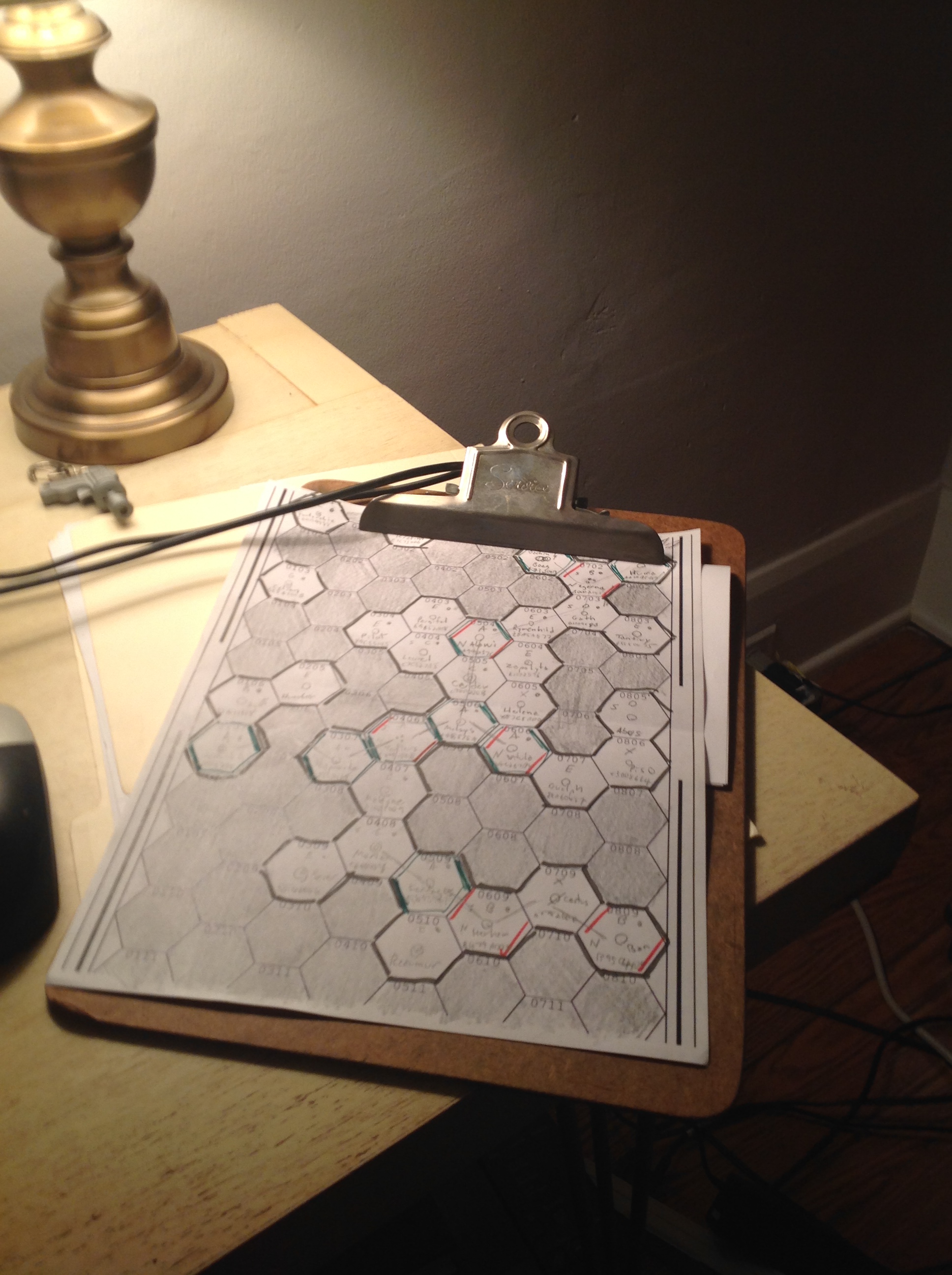
I grab it and read the core rules for my own non-writing enjoyment, including the extensive map and world creation section. All based on die rolls.
Now, randomness is a major element in this fictional world. It powers interstellar flight. It [REDACTED FOR SPOILER]. Characters obsess over it. It’s a thing. And here, lain out before me in all its non-OCR-scanned PDF glory, is a method to make a detailed sector map using chance. Magnificent.
So I get to rolling. Oh sure. I could use an online tool. But what fun would that be?
I am now in possession of a map of the sector into which Zeno and friends (and enemies, mostly) are about to jump. And where will they make their rendezvous with the smugglers of the Ghost Parade? In the short-cut space between Guelph and ringed Cestus? Over the undefended water world of Celion?
Each hex has a story, and the borders between as well. Naturally, the majority of the ruleset doesn’t apply to my world, but that’s not what I’m looking for. I just want something to elicit some conflict, some history. Some story.
I’m not saying it’s the best method — but it’s sure helped me flesh things out.
First Law: A drone may not injure a government agency or designated corporation or, through inaction, allow a government agency or designated corporation to come to harm.
Second Law: A drone must obey the orders given to it by a government agency or designated corporation, except where such orders would conflict with the First Law.
Third Law: A drone must protect its own ability to gather data and attack both aerial and ground targets as long as this does not conflict with the First or Second Laws.
Brilliant writer Ken Liu pointed out a Guardian article, which prompted the drafting of these laws on Twitter. Look for them in a constitution near you.